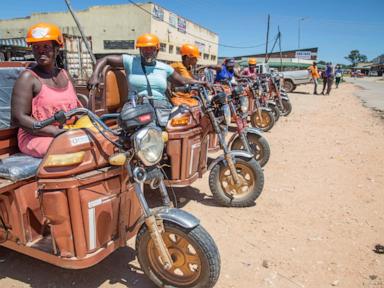
In Zimbabwe, the electric vehicle revolution began on rural dirt paths, where three-wheeled vehicles carry cabbages to markets, women farmers to their fields and patients to clinics in communities where transport has long been scarce. For farmer Agefi Mutambo, who has owned an electric three-wheeler since 2021, the change has transformed her business and family. Previously she walked seven to 10 kilometers balancing a 20-kilogram bucket of tomatoes on her head, selling it for $6, a sum that was not even enough for food.
Now the 56-year-old makes two to three deliveries a week, carrying 300 kilograms of produce on each trip and grossing roughly $80 a trip by supplying schools and clinics. She also ferries neighbors to hospital, sometimes at midnight for a woman in labor. When her battery runs low, she swaps it for $4 and is back on the road. Mutambo is among dozens of rural women entrepreneurs whose lives have been changed by electric tricycles introduced in 2019 by local social enterprise Mobility for Africa.S1S2
The company's solar-charged tricycles, powered by lithium-ion batteries and aimed mainly at rural women, are offered under a lease-to-own scheme costing about $30 a week. Called "Hamba," meaning "go" in the local Ndebele language, the vehicles can carry loads of over 400 kilograms and travel about 100 kilometers on a single charge. Solar-powered charging stations and swappable batteries let drivers exchange depleted batteries rather than wait for them to recharge.S1S2
Across parts of Africa, motorcycles and three-wheelers are emerging as a route to electric mobility, particularly in rural communities long overlooked by conventional mobility businesses. While electric cars gain ground in wealthier markets, these smaller vehicles can operate with less extensive and expensive charging infrastructure, offering a potentially cheaper leapfrog to electrification for a continent of 1.5 billion people.S1S2
Africa holds vast reserves of critical minerals used in electric vehicle batteries, yet it remains a minor player in the global EV market. It sold about 25,000 electric cars in 2025, concentrated in Egypt, Morocco and South Africa, compared with more than 20 million worldwide, according to the International Energy Agency's Global EV Outlook 2026. The United Nations Economic Commission for Africa has identified unreliable electricity infrastructure, limited technical capacity and weak regulation as barriers to adoption.S1S2
Even so, the market for small electric vehicles used in everyday transport, deliveries and commerce is growing, said e-mobility expert Hezbon Mose. He said Africa's transition is largely centered on income-earning motorcycles and three-wheelers, with Ethiopia an exception because of its car-focused policies.S1S2