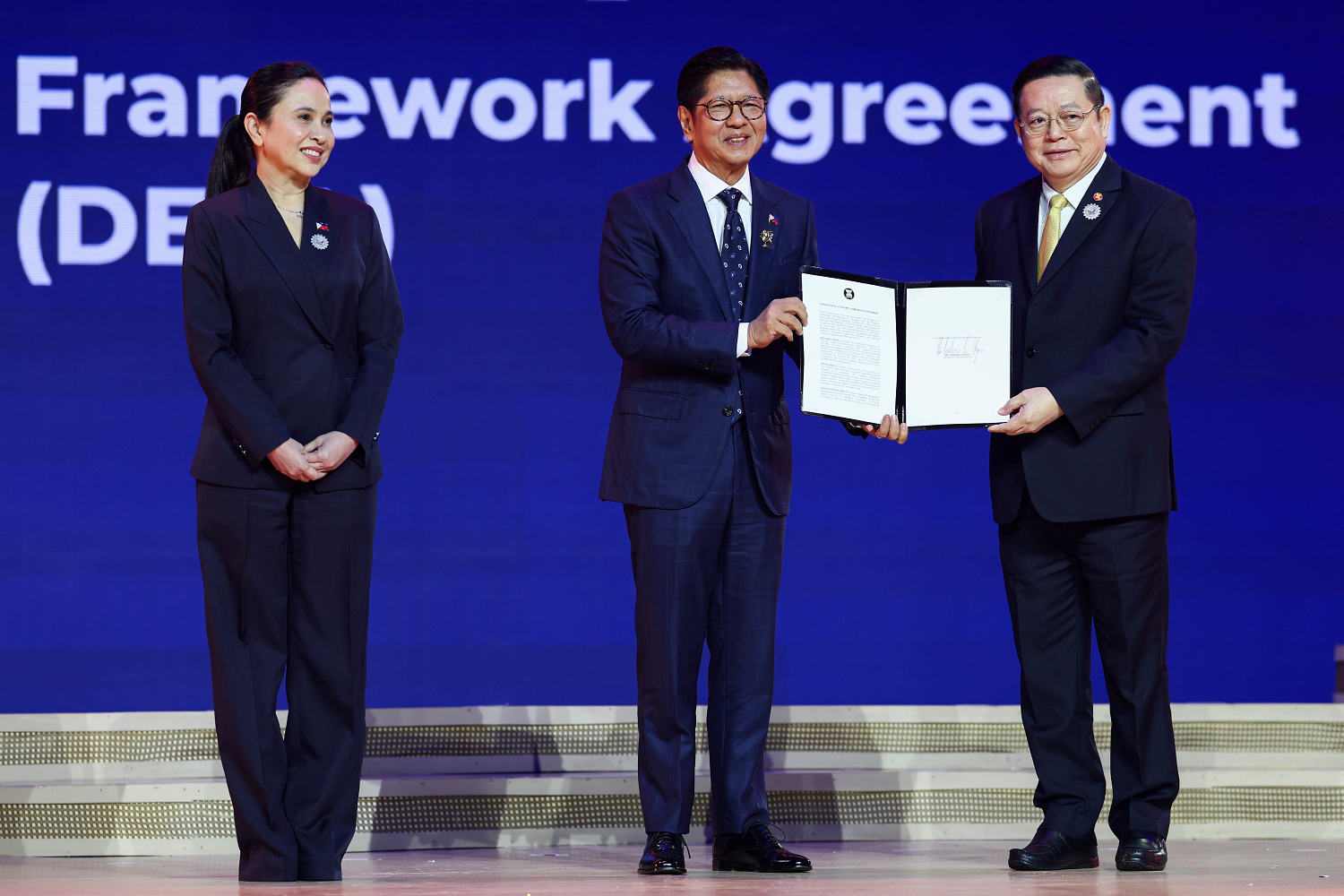
Southeast Asian leaders opened their annual summit in the Philippine capital Manila on Sunday for three days of talks, including dialogues with world leaders led by U.S. President Donald Trump, whose trip to Asia could help boost his standing after his party's defeat in the midterm elections. The talks by the Association of Southeast Asian Nations and their expanded discussions with Asian and Western heads of state are set to focus on the world's most troubling conflicts, led by the war in the Middle East, according to drafts of post-summit communiques seen by The Associated Press.
Trump is expected to land in Manila with U.S. Secretary of State Marco Rubio on Tuesday afternoon, after the main ASEAN summit meetings have concluded and Philippine President Ferdinand Marcos Jr. turns over the regional bloc's rotating annual leadership to Singapore. Trump will join three key meetings late Tuesday, including a meeting of the Quadrilateral Security Dialogue, consisting of the United States, Japan, Australia and India, a grouping largely seen as a counterweight to China, and a special summit with ASEAN leaders over cocktails. He will meet Marcos on Wednesday, who will receive him with a red-carpet welcome and a state luncheon.S1S2
The leaders are likely to renew calls for self-restraint and peaceful resolution of conflicts, including longstanding disputes in the South China Sea and a civil war in Myanmar, and to press efforts to shield their economies and citizens from fallout from global conflicts. The draft statement says the leaders reaffirmed their commitment to international law, including the United Nations Charter, and underlines the importance of peaceful resolution of disputes and freedom of navigation and overflight.S1S2
Marcos told counterparts in a heavily secured convention center by Manila Bay that unity matters more as the region faces shifting tides, geopolitical tensions, economic uncertainty, new technologies, climate change and transnational threats, warning that problems across the world "are reshaping our region faster than any one country can respond to alone." Unity has long been elusive in ASEAN, a diverse bloc of democracies and authoritarian states, many aligned with the United States or China, and the group is often better known for photo-ops projecting unity than for effectively dealing with conflicts including Myanmar and the South China Sea.S1S2