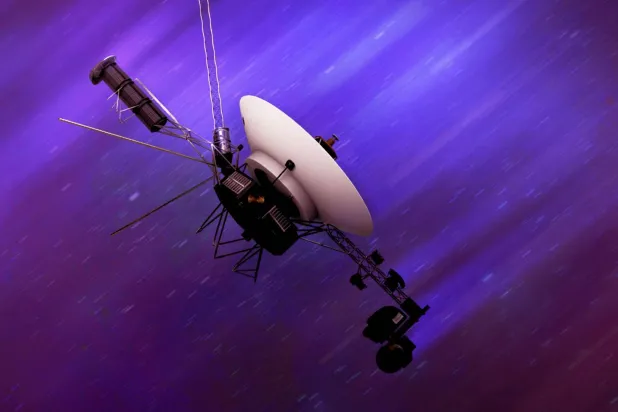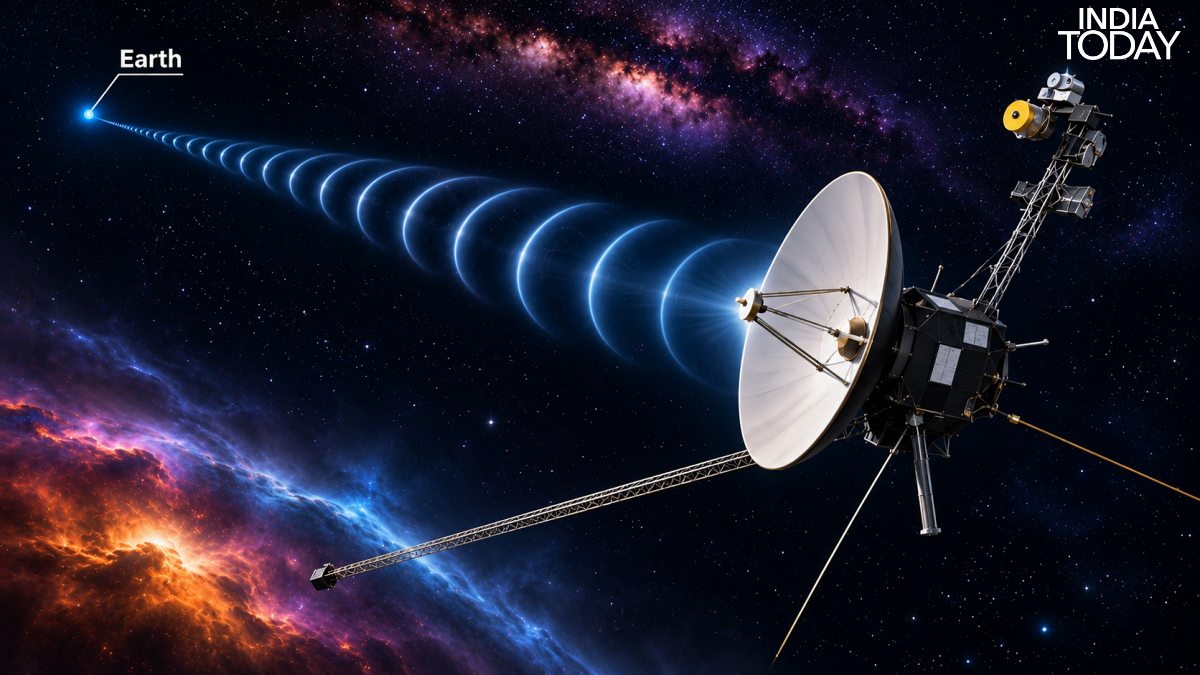
NASA's Voyager 1 has crossed a milestone that puts the scale of interstellar space into perspective. On November 18, at 3:46 PM IST, the spacecraft became the first human-made object to reach one light-day from Earth, a distance of approximately 25.9 billion kilometres. A light-day is the distance light travels in 24 hours, roughly 3,00,000 kilometres per second.
Voyager 1 was launched on September 5, 1977, just 16 days before its twin, Voyager 2. The pair was designed to explore the outer planets. Voyager 1 flew past Jupiter in 1979 and Saturn in 1980, sending back observations of the planets, their moons and rings. Its encounter with Saturn's moon Titan set it on a path out of the plane of the planets. In August 2012 it crossed the heliopause, the boundary at the outer edge of the Sun's protective bubble of particles and magnetic fields, becoming the first spacecraft to enter interstellar space.S1
At around 61,000 kilometres per hour, the craft needed nearly five decades to reach this distance. Because of the distance, a radio signal from Earth takes about 24 hours to reach it, and any reply takes another 24 hours to return, making a simple exchange a two-day affair.S1
The spacecraft does not rely on solar panels. It uses radioisotope thermoelectric generators, which convert heat from the radioactive decay of plutonium-238 into electricity. That power is steadily declining, so NASA engineers have progressively switched off scientific instruments and non-essential systems to conserve what remains. It also runs on computers and memory systems developed in the 1970s, with engineers managing the ageing systems through carefully designed commands.S1