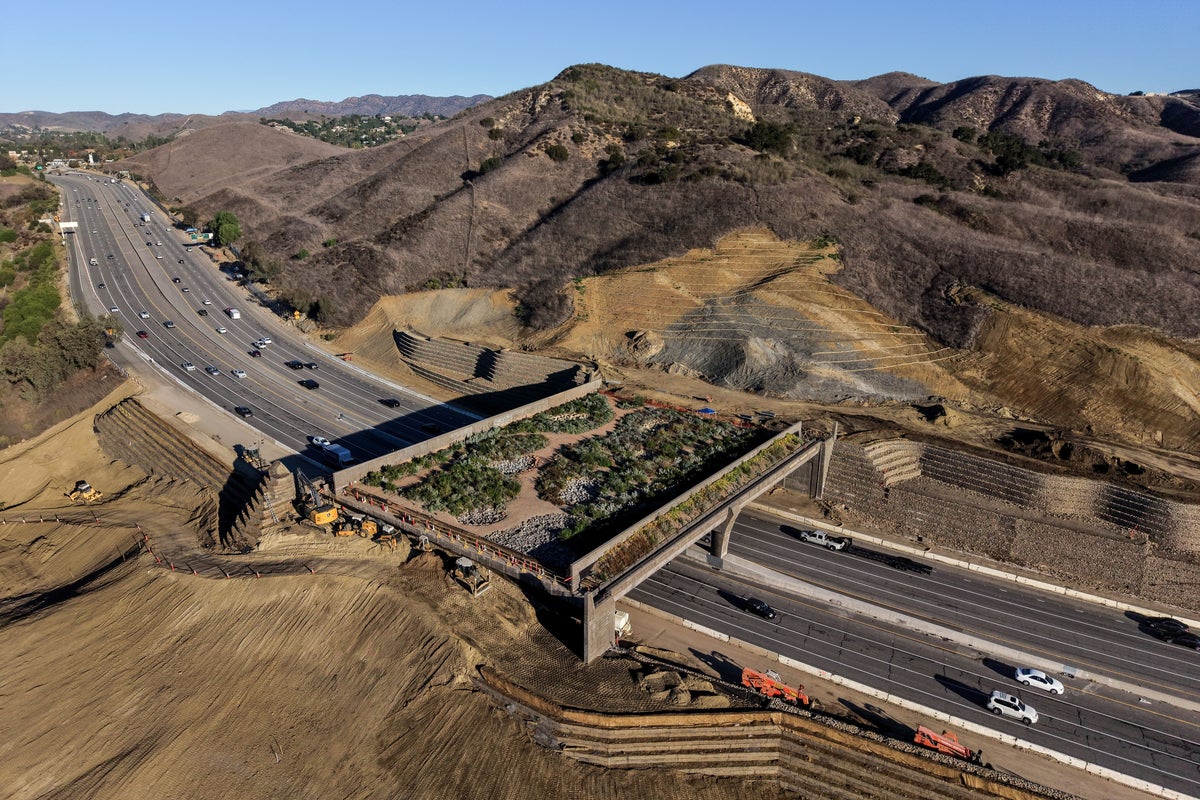
The world's largest wildlife overpass, the Wallis Annenberg Wildlife Crossing, is already being used by animals ahead of its formal opening ceremony on Dec. 2. The bridge spans U.S. 101 and an adjacent frontage road in Agoura Hills, about 35 miles (56 kilometers) northwest of downtown Los Angeles, where roughly 300,000 vehicles pass each day. Beth Pratt, president of the nonprofit Wildlife Crossing Fund and a key figure behind the project, said birdsong could be heard on the newly planted native vegetation atop the span.
Motion-sensor cameras first recorded a lone coyote, believed to be the first mammal to cross safely, about two weeks before the opening. Shortly afterward, three young coyotes were filmed playing beneath the 10-foot (3-meter) sound walls lining the structure. Fencing along the freeway funnels wildlife toward the crossing. The bridge is designed to blend into the surrounding hills and stretches 1,250 feet (380 meters) in two sections, giving animals hemmed in by urban growth a route to the Santa Monica Mountains and beyond.S1S2
The crossing is named for the late philanthropist Wallis Annenberg, whose foundation donated $25 million toward a $114 million total cost, up from an initial $92 million. The funds came from 6,000 public donors, nonprofit grants and state conservation funds. Leonardo DiCaprio was among the earliest donors when fundraising began a decade ago.S1S2
The project was inspired by P-22, a well-known mountain lion that crossed major freeways to settle in a large Los Angeles park. P-22 was euthanized in 2022 after a likely vehicle strike, and thousands attended his memorial. GPS tracking of mountain lions over decades showed that major roads confined animals within coastal ranges near Malibu and across central Los Angeles toward Griffith Park. Pratt said the bridge will be truly inaugurated when a mountain lion, a species listed as threatened in California, uses it to cross.S1S2