Thai Court Upholds Royal Defamation Conviction of Opposition Lawmaker, Reduces Sentence to Three Years

Thailand
The brief

Thailand's appeals court on Monday upheld the conviction of opposition lawmaker Rukchanok Srinork for defaming the monarchy in social media posts, while cutting her prison term from six years to three. Rukchanok, a member of the People's Party, had been prosecuted under the lese majeste law and the Computer Crime Act, and in 2023 was found guilty over two posts and sentenced to six years in prison.

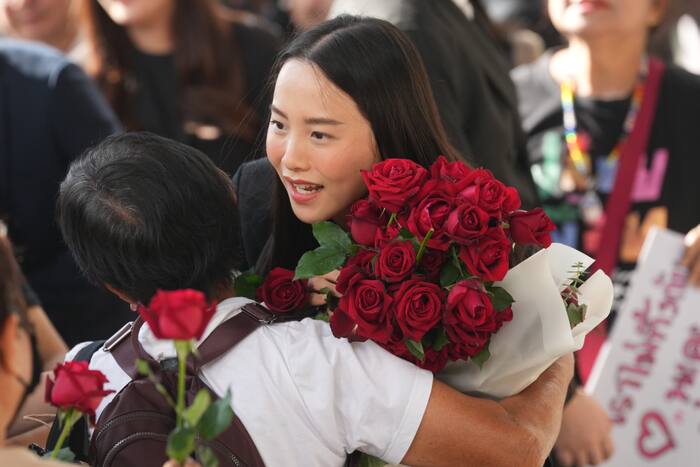
In a statement, the appeals court said it upheld the conviction tied to one post but dismissed the charge involving the other. The revised three-year sentence was issued under the lese majeste law, which carries harsher penalties than the broader Computer Crime Act governing online conduct. Several fellow party members accompanied Rukchanok to the hearing, and supporters outside the Bangkok court greeted her with red roses before she went inside.S1S2

People's Party leader Natthaphong Reungpanyawut said the court dropped the charge linked to one post because the evidence was insufficient. Rukchanok is set to appeal to the Supreme Court, and her release on bail has been granted. Had bail been denied and she been taken into custody, she would have immediately lost her parliamentary seat.S1S2

The posts were published on X, formerly Twitter, in 2021. One reportedly criticized the monarchy over its links to a coronavirus vaccine, while the other reshared an anti-monarchy message. Rukchanok has denied writing the posts herself.S1S2

The ruling, though widely anticipated, underlines the continued influence of Thailand's conservative political establishment and its sensitivity to criticism seen as threatening the monarchy. The progressive People's Party is now the main opposition in Parliament after placing second to the conservative Bhumjaithai Party in this year's election.S1S2

The lese majeste provision, Article 112 of Thailand's Criminal Code, remains deeply controversial. Critics point to cases in which people have been prosecuted for conduct as minor as liking a Facebook post, and object to rules allowing anyone to file a complaint, which often results in detention during lengthy proceedings. Convictions for defaming the monarchy can carry prison terms of up to 15 years. Thai Lawyers for Human Rights reports that more than 290 people, many of them student activists, have faced charges under Article 112 since early 2020, a period that followed student-led pro-democracy protests calling for reforms to the law.S1S2


Timeline · newest first
1h Internewscast

Thai Court Upholds Royal Defamation Conviction of Opposition Lawmaker, Reduces Sentence to Three Years

Internewscast Internewscast BANGKOK – Thailand’s appeals court on Monday upheld the conviction of opposition… This Post: Thai Court Upholds Royal Defamation Conviction of Oppositio…

1h Click2houston

Thai court upholds royal defamation conviction for opposition lawmaker and cuts sentence to 3 years

An appeals court has upheld the conviction of an opposition lawmaker for defaming Thailand’s monarchy in social media posts but reduced her prison sentence from six years to three.

Thai Court Upholds Royal Defamation Conviction of Opposition Lawmaker, Reduces Sentence to Three Years

2 outlets 2 reports
The brief

Thailand's appeals court on Monday upheld the conviction of opposition lawmaker Rukchanok Srinork for defaming the monarchy in social media posts, while cutting her prison term from six years to three. Rukchanok, a member of the People's Party, had been prosecuted under the lese majeste law and the Computer Crime Act, and in 2023 was found guilty over two posts and sentenced to six years in prison.

In a statement, the appeals court said it upheld the conviction tied to one post but dismissed the charge involving the other. The revised three-year sentence was issued under the lese majeste law, which carries harsher penalties than the broader Computer Crime Act governing online conduct. Several fellow party members accompanied Rukchanok to the hearing, and supporters outside the Bangkok court greeted her with red roses before she went inside.S1S2

People's Party leader Natthaphong Reungpanyawut said the court dropped the charge linked to one post because the evidence was insufficient. Rukchanok is set to appeal to the Supreme Court, and her release on bail has been granted. Had bail been denied and she been taken into custody, she would have immediately lost her parliamentary seat.S1S2

The posts were published on X, formerly Twitter, in 2021. One reportedly criticized the monarchy over its links to a coronavirus vaccine, while the other reshared an anti-monarchy message. Rukchanok has denied writing the posts herself.S1S2

The ruling, though widely anticipated, underlines the continued influence of Thailand's conservative political establishment and its sensitivity to criticism seen as threatening the monarchy. The progressive People's Party is now the main opposition in Parliament after placing second to the conservative Bhumjaithai Party in this year's election.S1S2

The lese majeste provision, Article 112 of Thailand's Criminal Code, remains deeply controversial. Critics point to cases in which people have been prosecuted for conduct as minor as liking a Facebook post, and object to rules allowing anyone to file a complaint, which often results in detention during lengthy proceedings. Convictions for defaming the monarchy can carry prison terms of up to 15 years. Thai Lawyers for Human Rights reports that more than 290 people, many of them student activists, have faced charges under Article 112 since early 2020, a period that followed student-led pro-democracy protests calling for reforms to the law.S1S2

Timeline · newest first

Sources · 2 citations

S1 Internewscast 1 report · EN
S2 Click2houstonLead 1 report · EN
Share this story

Thai Court Upholds Royal Defamation Conviction of Opposition Lawmaker, Reduces Sentence to Three Years