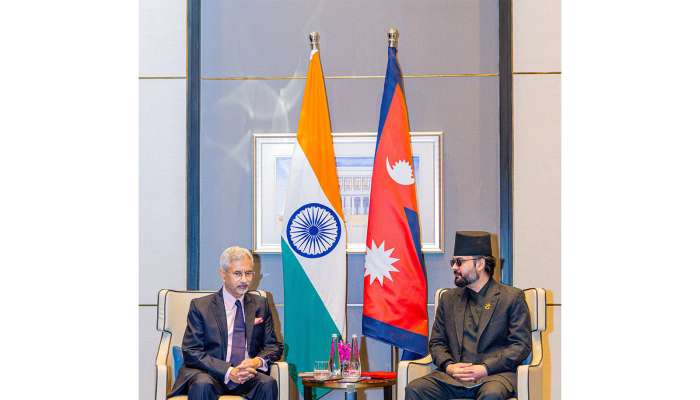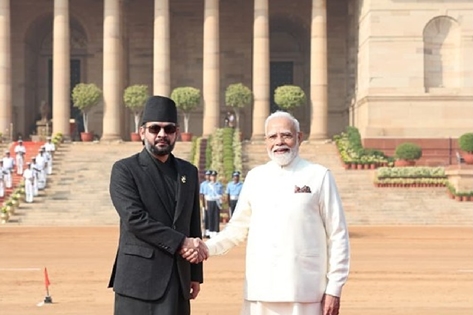
India on Monday, 23 November, announced a Rs 15,000 crore development assistance package for Nepal, along with a series of cross-border connectivity and energy projects, after Prime Minister Narendra Modi held talks with his Nepalese counterpart Balendra Shah in New Delhi. Shah, who took office in March, was on his first bilateral visit abroad.
The two leaders flagged off the Sarayu-Kamala Express, a weekly train linking Ayodhya Cantt in Uttar Pradesh with Janakpur Dham in Nepal, with stoppages at Gorakhpur, Basti, Raxaul, Sitamarhi, Madhubani and Jaynagar. They also laid the foundation stone of the 669 MW Lower Arun Hydroelectric Project and dedicated the second phase of the Motihari-Amlekhgunj Pipeline. Foundation stones were laid for a petroleum terminal at Jhapa and an Integrated Check Post at Banbasa in Uttarakhand, and a motorable bridge linking Dharchula and Darchula was opened.S1S2
Eight memorandums of understanding were signed covering space technology, security and forensic training, civil service capacity building, healthcare, traditional medicine, sustainable urban development, and livestock and fisheries development. Modi also announced a startup incubator, an innovation hub, an offshore IIT campus and an agro-industrial park in Nepal, along with more scholarships for Nepali students in law and technology.S1S2
Modi described the relationship as "not merely one of neighbours, but one of kinship and unbreakable trust", and said India had kept up supplies of fuel, fertilisers and essentials to Nepal despite oil disruptions from the West Asia conflict. Shah said the ties stood "as firm as the Himalayas" and described India as a first responder in natural disasters.S1S2
Shah departed for Kathmandu on Monday afternoon, concluding his two-day state visit, and was seen off at Indira Gandhi International Airport by Union Minister of State for Commerce and Industry Jitin Prasada and Nepal's Ambassador to India Nishchal Nath Pandey, among others.S2