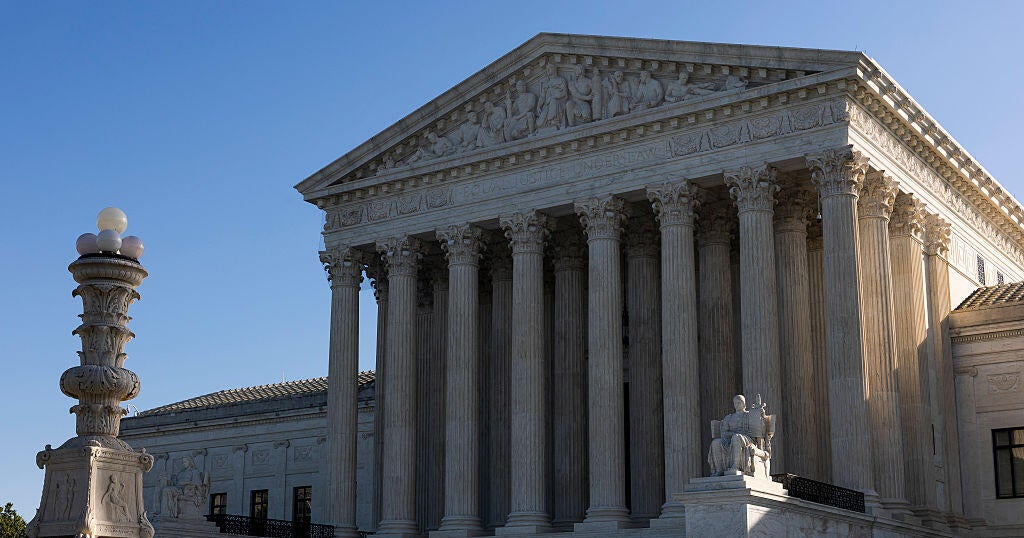
The Supreme Court on Monday declined to hear a broad challenge to Maryland's restrictions on carrying firearms in a wide range of public areas, leaving the state's rules in place. The justices did not use the case to define what exactly counts as a "sensitive place," a term earlier rulings used to describe locations where guns could be banned. The Maryland restrictions bar carrying firearms in state parks, on public transport, on school property, in healthcare facilities and in places that sell alcohol.
The court's 6-3 conservative majority has frequently backed gun rights, expanding the scope of the Second Amendment in a series of rulings. Justice Clarence Thomas wrote a brief statement agreeing with the decision not to take up the case in part because so many distinct provisions were being challenged, saying "the breadth of petitioners' challenge would complicate our review." He signaled interest in a future case that would be "more narrowly focused," and said he was "skeptical" that the various Maryland provisions are lawful.S1
Some of the challenged provisions were enacted in 2023, after the Supreme Court's 2022 ruling found for the first time a right to carry a firearm outside the home and set a new test for assessing gun restrictions based on whether a law fits a historical understanding of the Second Amendment. A 2008 ruling had said nothing should be read to cast doubt on laws forbidding firearms in sensitive places such as schools and government buildings. Gun rights advocates concede a long history of bans at polling places, courthouses and legislatures, but argue Maryland has extended such bans to modern public places such as airports and entertainment districts.S1S2
A federal district court declined to block limits on museums, health care facilities, public transit, state parks, entertainment venues, school grounds and government buildings, but ruled for the plaintiffs on public demonstrations and places that sell alcohol for on-site consumption. The U.S. Court of Appeals for the 4th Circuit then found all of the challenged restrictions consistent with the Second Amendment, pointing to historical analogues and to Supreme Court decisions from 2008 and 2010 that had described bans on guns in government buildings and on school grounds as permissible.S2
The challengers, who included individual Maryland residents and four gun rights groups, argued the restrictions were so broad they severely limit the ability to carry firearms in public at all. Maryland Attorney General Anthony Brown, a Democrat, urged the court not to take up the case, saying there are "vast areas of shared consensus" over which locations should be considered sensitive places. Other states with similarly broad restrictions include California, New York, New Jersey and Hawaii.S1S2